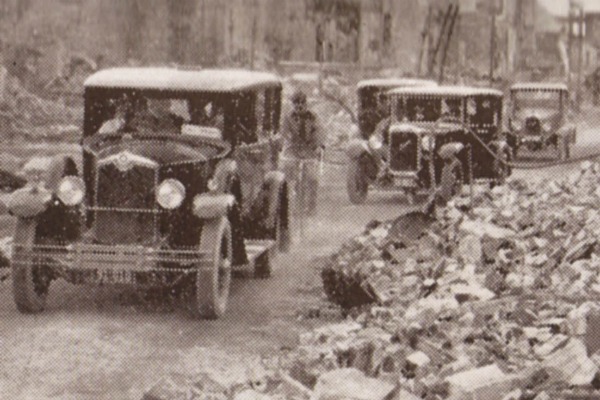
Bigwigs: cars wend their way down a lane cleared through the rubble of the 1931 Napier earthquake in a scene which may resonate with Christchurch people upset that only dignitaries appear to be getting access to the Chch CBD. The caption notes that the lead car carried a (not named) Cabinet Minister. Illustration scanned from the book "the Hawkes Bay Earthquake" by Robert McGregor, first published 1998 by the Art Deco Trust of Napier
It is 81 years, this month, since a 7.8 magnitude quake shattered Hawke's Bay, killing 258 people. More than 400 were hospitalised with serious injuries and more than 2500 were hurt. It was a national disaster. Relief efforts drew in the whole country. Like Christchurch, the district was rocked for months afterwards by aftershocks that seemed to have no end.
Devastation was so great in Napier's town centre - also gutted by fire - that it had to be rebuilt from scratch. And speed was of the essence. The quake came atop a major recession - one that soon turned into the worst depression in national history. Townsfolk could not be hung out to dry. To get results, the Government replaced the Napier Borough Council with a two-man commission, geared to cut through red tape.
It all happened very quickly. J S Barton - a retired magistrate - and L B Campbell of the Public Works Department were appointed on March 11, just five weeks after the quake.
First priority was getting the commercial heart of the town beating again. Within a few months a temporary shopping centre - "Tin Town" - was operating on the edge of the CBD.
Work started as soon as possible on the permanent rebuild. Survey records had been destroyed in the quake, risking protracted argument, but Barton and Campbell used their powers to cut straight through all debate. Property owners got compensation - later.
The first new downtown building was under way just months after the quake. Work gained pace when the Government passed new building regulations in 1932.
The town centre, with a fair number of new buildings already complete, was formally re-opened just 23 months after the disaster.
Barton and Campbell were so popular there was talk afterwards of getting rid of the old council and keeping them on as town administrators.
Napier's experience stood in sharp contrast to Hastings. The town once touted as the "Christchurch of the north" had not been as heavily hit as Napier.
The Government saw no need to appoint commissioners. The council, under Mayor G F Roach, got to work with a will, getting services back up and issuing 194 permits for temporary buildings to get the town centre running again.
But recovery soon wallowed amidst in-fighting, the biggest battle being over whether to widen the town's main street.
Internal Affairs Department town planner J W Mawson set the cat among the pigeons in April 1931, when he told a public meeting that new buildings should be set back 1.8 metres along Heretaunga St between Willowpark and Tomoana roads. A former mayor George Ebbett, who owned property in the street, petitioned the council to stop it. Roach countered by setting his own temporary premises back in anticipation and launching a counter-petition. Although property owners led by Ebbett voted 21-6 against, the council decided to adopt the scheme. But then it stalled amid a further counter-attack from Ebbett.
All this was in line with local body processes of the day - in some ways reflecting the battle lines of pre-quake politics. But the upshot was reconstruction along the main street was delayed for months. Many of the temporary buildings were still there in the mid-1930s and in 1939 nine were reclassified as permanent.
History and circumstance never quite repeat - the past is in many ways a foreign land. But past experiences can still offer perspectives.
* Matthew Wright is one of New Zealand's most published historians.
Fairfax NZ News


 Share Topic


 March 21, 2012, 12:32:27 AM
